Identify & Remove Invasive Species
Summary: Learn about Groton's invasive species and start to remove them from home landscape.
Description
Key Characteristics of Invasive Plant Species:
-
Rapid Growth and Reproduction: Invasive plants often grow quickly and reproduce prolifically, both by seeds and vegetative means (e.g., rhizomes, stolons).
-
High Dispersal Ability: They can easily spread to new areas through various means, such as wind, water, animals, or human activities.
-
Lack of Natural Predators: Invasive plants often lack the natural predators or diseases that kept them in check in their native habitats, allowing them to dominate new environments.
-
Adaptability: These species can often thrive in a wide range of environmental conditions, including poor soils, varying climates, and disturbed areas.
Deep Dive
Plants Voted as: INVASIVE in Massachusetts by the Plant Evaluation Subcommittee of the Massachusetts Invasive Plant Working Group March 14, 2003
Aegopodium podagraria L. Bishop’s goutweed, bishop’s weed, goutweed
Form: growth habit – forb/herb; Habitat: region - entire state; environment – upland, wetland; light tolerance – all. Notes: Escapes from cultivation; spreads aggressively by roots; forms dense colonies in flood plains
Ailanthus altissima (P. Miller) Swingle Tree of heaven
Form: growth habit – tree/duration perennial; Habitat: region - entire state; environment - upland, wetland, & coastal; light tolerance – all. Notes: spreads aggressively from root suckers, especially in disturbed areas
Alliaria petiolata (Bieb.) Cavara & Grande Garlic mustard
Form: growth habit - forb/herb; duration - biennial Habitat: region - entire state; environment - upland; light tolerance - shade. Notes: spreads aggressively by seed, especially in wooded areas:
Berberis thunbergii DC. Japanese barberry
Form: growth habit - shrub; duration - perennial Habitat: region - entire state; environment - upland, wetland; light tolerance – full sun to shade Notes: escaping from cultivation; spread by birds; forms dense stands
Cabomba caroliniana A.Gray Carolina fanwort; fanwort
Form: growth habit - forb/herb; duration - perennial Habitat: region - entire state; environment - aquatic; light tolerance - not applicable Notes: common in the aquarium trade; chokes waterways
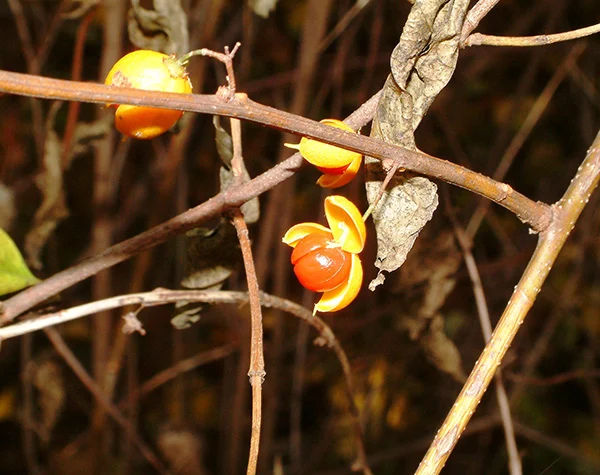
Celastrus orbiculatus Thunb. Asian or, Asiatic bittersweet, oriental bittersweet
Form: growth habit - vine; duration - perennial Habitat: region - entire state; environment - upland; light tolerance - full sun, partial shade Notes: escaping from cultivation; berries spread by birds and humans; overwhelms and kills vegetation
Cynanchum louiseae Kartesz & Gandhi Black swallow-wort, Louise’s swallow-wort
Form: growth habit - vine; duration - perennial Habitat: region - entire state; environment - upland, wetland, coastal; light tolerance - full sun, partial shade Notes: forms dense stands out- competing native species: deadly to Monarch butterflies.
Elaeagnus umbellata Thunb. Autumn olive
Form: growth habit - shrub; duration - perennial Habitat: region - entire state; environment - upland; light tolerance - full sun Notes: escaping from cultivation; berries spread by birds; aggressive in open areas; has the ability to change soil chemistry
Frangula alnus P. Mill. European buckthorn, glossy buckthorn
Form: growth habit - shrub, tree; duration - perennial Habitat: region - entire state; environment - upland, wetland, coastal; light tolerance - full sun, shade Notes: produces fruit throughout the growing season; grows in multiple habitats; forms dense thickets.
Glaucium flavum Crantz sea or horned poppy, yellow hornpoppy
Form: growth habit - forb/herb; duration - biennial, perennial Habitat: region - southeastern; environment - coastal; light tolerance - full sun Notes: seeds float; spreads along rocky beaches; primarily Cape Cod and Islands
Hesperis matronalis L. Dame’s rocket
Form: growth habit - forb/herb; duration - biennial, perennial Habitat: region - entire state; environment - upland, wetland; light tolerance - full sun, shade Notes: spreads by seed; can form dense stands, particularly in flood plains
Iris pseudacorus L. Yellow iris
Form: growth habit - forb/herb; duration - perennial Habitat: region - entire state; environment - wetland; light tolerance - full sun, partial shade Notes: found primarily in flood plains; out- competes native plant communities
Lepidium latifolium L. broad-leaved pepperweed, tall pepperweed
Form: growth habit - forb/herb; duration - perennial Habitat: region - eastern, southeastern; environment - coastal; light tolerance - full sun Notes: primarily coastal at upper edge of wetlands; also found in disturbed areas; salt tolerant
Lonicera x bella Zabel [morrowii x tatarica] Bell’s honeysuckle
Form: growth habit - shrub; duration - perennial Habitat: region - entire state; environment - upland, wetland, coastal; light tolerance - full sun, shade Notes: part of a confusing hybrid complex of nonnative honeysuckle commonly planted and escaping from cultivation via bird dispersal
Lonicera japonica Thunb. Japanese honeysuckle
Form: growth habit - vine; duration - perennial Habitat: region - entire state; environment - upland, wetland, coastal; light tolerance - full sun, shade Notes: rapidly growing, dense stands climb and overwhelm native vegetation; produces many seeds that are bird dispersed; more common in southeastern Massachusetts.
Lonicera morrowii A.Gray Morrow’s honeysuckle
Form: growth habit - shrub; duration - perennial Habitat: region - entire state; environment - upland, wetland, coastal; light tolerance - full sun, shade Notes: part of a confusing hybrid complex of nonnative honeysuckle commonly planted and escaping from cultivation via bird dispersal
Lysimachia nummularia L. Creeping jenny, moneywort
Form: growth habit - forb/herb; duration - perennial Habitat: region - entire state; environment - upland, wetland; light tolerance - full sun, shade Notes: escaping from cultivation; problematic in flood plains, forests and wetlands; forms dense mats
Lythrum salicaria L. Purple loosestrife
Form: growth habit - forb/herb, subshrub; duration - perennial Habitat: region - entire state; environment - upland, wetland; light tolerance - full sun, partial shade Notes: escaping from cultivation; overtakes wetlands; high seed production and longevity
Myriophyllum heterophyllum Michx. Twoleaved water-milfoil, variable water-milfoil Form: growth habit - forb/herb; duration - perennial Habitat: region - entire state; environment - aquatic; light tolerance - not applicable Notes: chokes waterways, spread by humans and possibly birds
Myriophyllum spicatum L. Eurasian or European water-milfoil, spike water-milfoil
Form: growth habit - forb/herb; duration - perennial Habitat: region - entire state; environment - aquatic; light tolerance - not applicable Notes: chokes waterways, spread by humans and possibly birds
Phragmites australis (Ceav.) Trin. ex Steud. common reed
Form: growth habit -graminoid (USDA lists as subshrub, shrub); duration - perennial Habitat: region - entire state; environment - upland, wetland; light tolerance - full sun, shade Notes: overwhelms wetlands forming huge, dense stands; flourishes in disturbed areas; native and introduced strains.
Polygonum cuspidatum Sieb. & Zucc. Japanese knotweed; Japanese Bamboo
Form: growth habit -forb/herb, subshrub, shrub; duration - perennial Habitat: region - entire state; environment - upland, wetland, coastal; light tolerance - full sun, shade Notes: Spreads vegetatively and by seed; forms dense thickets.
Potamogeton crispus L. Crisped pondweed, curly pondweed
Form: growth habit - forb/herb; duration - perennial Habitat: region - entire state; environment - aquatic; light tolerance - not applicable Notes: forms dense mats in the spring and persists vegetatively
Rhamnus cathartica L. Common buckthorn
Form: growth habit - shrub, tree; duration - perennial Habitat: region - entire state; environment - upland, wetland; light tolerance - full sun, shade Notes: produces fruit in fall; grows in multiple habitats; forms dense thickets
Robinia pseudoacacia Black locust
Form: growth habit – tree; duration – perennial Habitat: region – entire state; environment – upland; light tolerance – full sun, shade. Notes: While the species is native to central portions of Eastern North America, it is not indigenous to Massachusetts. It has been planted throughout the state since the 1700’s and is now widely naturalized. It behaves as an invasive species in areas with sandy soils.
Rosa multiflora Thunb. Multiflora rose
Form: growth habit - vine, shrub; duration - perennial Habitat: region - entire state; environment - upland, wetland, coastal; light tolerance - full sun, shade Notes: forms impenetrable thorny thickets that can overwhelm other vegetation; bird dispersed
Trapa natans L. Water-chestnut
Form: growth habit - forb/herb; duration – annual Habitat: region - western, central, eastern; environment - aquatic; light tolerance - not applicable Notes: forms dense floating mats on water
Steps to Take
Groton has an Invasive Species Committee. Check out the following links they have provided to help you learn what plants are invasive in Groton and how you can learn to identify them and start to remove them from your property.
- All Actions